Test the idea
Evaluate concepts, value propositions, workflows, and prototypes before investing further.
Healthcare Product Experience
Find where people lose their way, misunderstand instructions, or struggle to complete a task. We connect patient, caregiver, clinician, and staff research to clearer healthcare product decisions.
What it is for
Evaluate concepts, value propositions, workflows, and prototypes before investing further.
Identify the friction behind incomplete tasks, onboarding drop-off, and repeated work. Define a baseline before evaluating whether a change improves performance.
Rank navigation, content, accessibility, and workflow issues by the task affected, the evidence, and the consequence for the user.
Products evaluated
For patient portal onboarding, scheduling, and intake, study whether people can find the next step, understand what is required, and complete the process. Test terminology, instructions, and mobile interactions with the intended audience.
For clinical dashboards and EHR-connected workflows, examine how professionals find information and hand work to the next person. Clinical decision-support interfaces require a separate assessment of intended use and safety-related tasks.
Follow the work across referrals, enrollment, recurring tasks, documentation, and billing preparation. Map ownership and missing information so a product recommendation addresses the whole handoff, not just one screen.
Use concept reviews, wireframes, or interactive prototypes to test the riskiest assumptions before building. For live products, pair observed task behavior with product analytics when the data and consent support it.
Methods
The approach can be exploratory, evaluative, quantitative, or a focused combination.
Specialized evaluation
Check whether users can explain an instruction in their own words and act on it. Health literacy research can cover medical terminology, consent content, error messages, and the difference between understanding a claim and trusting it.
Heuristic evaluation, cognitive walkthrough, accessibility review, inclusive design, UX audit, and content audit.
Define the task and success criteria before measuring completion, time, or errors. SUS and UMUX-Lite summarize perceived usability; SEQ captures perceived ease after a task. Scores need a consistent study design and context to support comparisons.
Funnels, conversion, clickstream, heatmaps, session recordings, retention, and A/B testing.
Detailed deliverables
Findings, evidence, usability patterns, product implications, and recommendations.
Issue, affected task or screen, evidence, severity, frequency, and recommended fix.
Screen-level evidence and clear design, content, or interaction recommendations.
Steps, channels, frontstage and backstage interactions, pain points, and opportunities.
Task success, efficiency, perceived ease, error rate, and benchmark comparisons.
Recommended changes ranked by user impact, business impact, confidence, and effort.
Research plan, discussion guide, usability tasks, moderator guide, and screener.
Only the methods and deliverables required to answer the product question are included in the project scope.
Digital UX and medical device human factors
A confusing portal sign-up and an error during medical device use call for different research designs. Digital UX research can examine findability, comprehension, task completion, and workflow fit. A medical device human factors program also needs to consider intended users, use environments, use-related risks, and safety-critical tasks.
Formal human factors validation or work under IEC 62366-1 requires a separately defined scope and appropriate regulatory expertise. An exploratory workflow study does not establish device safety or satisfy a regulatory submission. We clarify that boundary before agreeing on the research plan.
Read FDA guidance on human factors and usability engineering →
Applied work
See a documented healthcare product design example, alongside market and audience studies that can inform a UX research brief.
HealthyFlow · Product strategy and workflow design
HealthyFlow connects program readiness, launch, daily operations, growth, and analytics. The case shows how a healthcare software concept was organized around enrollment, recurring work, evidence, and payment visibility.
This is an early-stage product definition case. It does not report completed usability tests or measured performance improvements.
Explore the HealthyFlow case →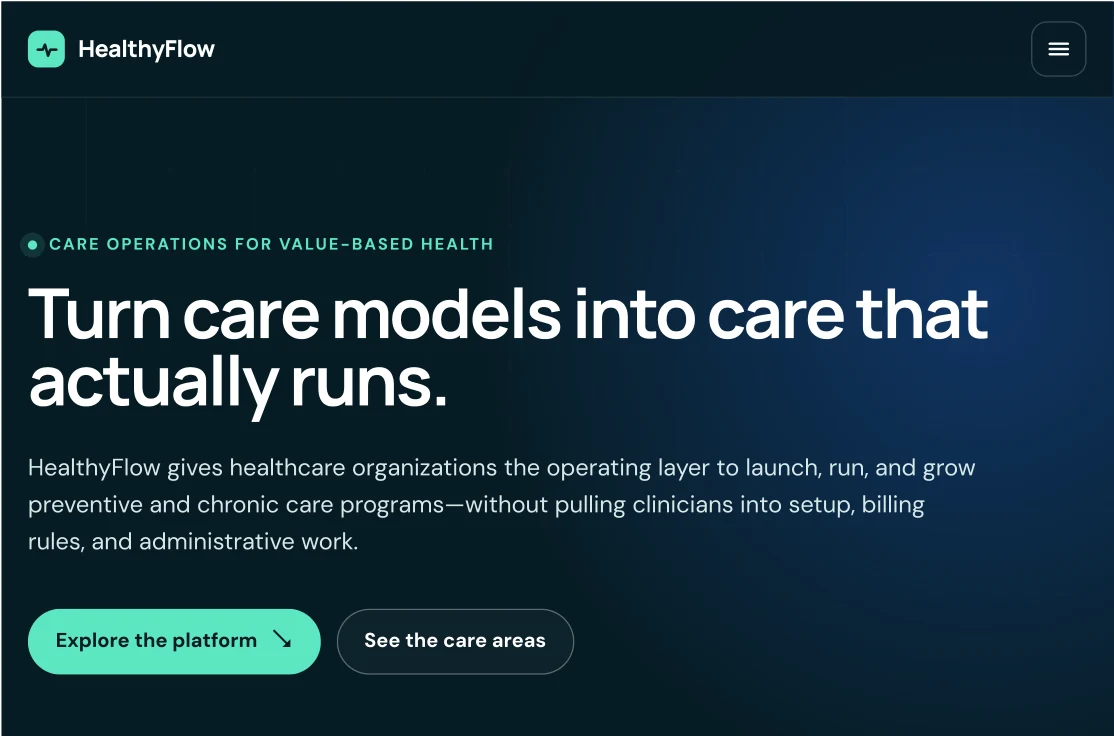
Questions before a project
We agree on consent, recording permissions, access, retention, and reporting before recruitment. Simulated or appropriately de-identified environments are preferred where they answer the question. If protected health information is required, HIPAA applicability, agreements, and the data environment must be confirmed before the study begins. Do not send patient-identifiable information through the quote form.
Yes. The audience is defined by the work: physicians, nurses, caregivers, patients, administrative staff, or other roles relevant to the product. Recruitment criteria, specialist access, study location, and feasibility are agreed during scoping.
Task completion and observed errors help evaluate whether a workflow works. Time on task describes efficiency under the study conditions. SEQ, SUS, or UMUX-Lite can add perceived ease or usability. We choose the measures after defining the decision and tasks, rather than collecting every score by default.
Yes. Workflow mapping, expert review, and prototype research can identify assumptions to test before launch. Those findings are separated from evidence collected with participants. The HealthyFlow case illustrates product and workflow definition; user validation remains a subsequent step.
No. Exploratory UX research and formal medical device validation have different purposes and evidence requirements. Safety-related intended use, critical tasks, regulatory expectations, and specialist responsibilities must be defined separately.
Get a quote
Share the product, audience, decision, and timeline. We will propose a focused research scope.